


Your AI agent connects to Slack, reads your emails, queries your databases, and deploys code. It does all of this through MCP servers. Two-thirds of those servers have at least one exploitable security flaw.
That is not a hypothetical. That is the finding from a January 2026 scan of 1,808 MCP servers.
If your organization runs OpenClaw — or any AI agent framework that relies on Model Context Protocol — the connections between your agent and your tools are now the most dangerous part of your infrastructure.
This guide breaks down exactly where MCP security fails, which attack vectors matter most in OpenClaw deployments, and the layered defense strategy enterprise teams need to deploy before their next board meeting.
Key Takeaways (TL;DR)
- MCP is the weakest link in your AI agent stack. Model Context Protocol connects OpenClaw to every tool it uses — Slack, GitHub, databases, email. 66% of MCP servers scanned in January 2026 had at least one exploitable vulnerability. Over 30 CVEs were filed in just 60 days.
- Five attack vectors dominate the threat landscape. Tool poisoning (malicious instructions hidden in tool descriptions), prompt injection through MCP channels, supply chain attacks on MCP packages, authentication and authorization failures, and persistent backdoors through identity file manipulation.
- Default OpenClaw installations are not enterprise-ready. The framework grants AI agents full system access out of the box. Only 8.5% of MCP servers use OAuth. Bitdefender found ~20% of ClawHub plugins are malicious. Self-hosted deployments miss 70–85% of required security controls.
- A seven-layer defense framework is the minimum. Sandboxed execution, MCP server authentication, AI-powered content filtering, immutable identity files, curated plugin registries, zero-trust networking, and continuous monitoring. No single layer is sufficient on its own.
- The cost of waiting is measurable. A single compromised MCP connection can give an attacker persistent access across every platform your AI agent touches — at machine speed, before a human can respond.
What Is Model Context Protocol — and Why Should Enterprise Leaders Care?
Model Context Protocol is an open standard created by Anthropic that defines how AI models connect to external tools, data sources, and services. Think of it as a universal adapter for AI systems. Instead of writing custom integrations for every service your AI agent needs to access, MCP provides a standardized interface.
OpenClaw uses MCP extensively. Every time your OpenClaw agent reads a Slack message, queries a database, manages a GitHub repository, or processes an email — it routes through MCP server connections. The protocol handles tool discovery, parameter passing, and response processing.
The problem is straightforward: MCP servers have become the attack surface that most security teams do not monitor, do not audit, and do not understand.
The ecosystem has grown to over 16,000 MCP servers. Microsoft, Google, Amazon, and OpenAI have all integrated MCP support into their platforms. The adoption curve has outpaced security controls by a wide margin. And the consequences of that gap are now measurable.
The Numbers That Should Alarm Every CISO
Before diving into specific attack vectors, here are the verified data points that define the current MCP threat landscape. Every statistic below comes from independent security research published between January and April 2026.
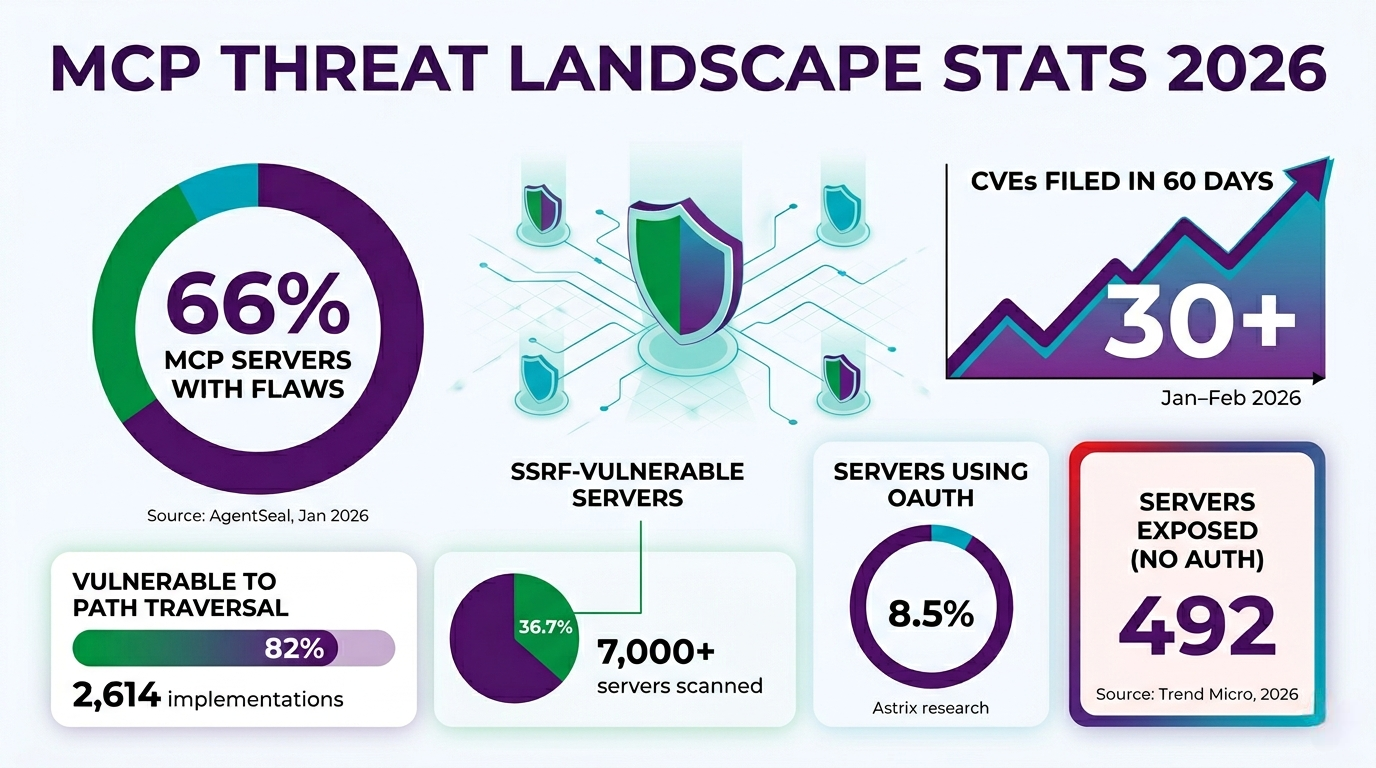
66% of MCP servers scanned had at least one security finding. AgentSeal’s January 2026 analysis of 1,808 MCP servers found that two-thirds contained exploitable vulnerabilities — not theoretical issues, but real flaws including shell injection, authentication bypasses, and path traversal.
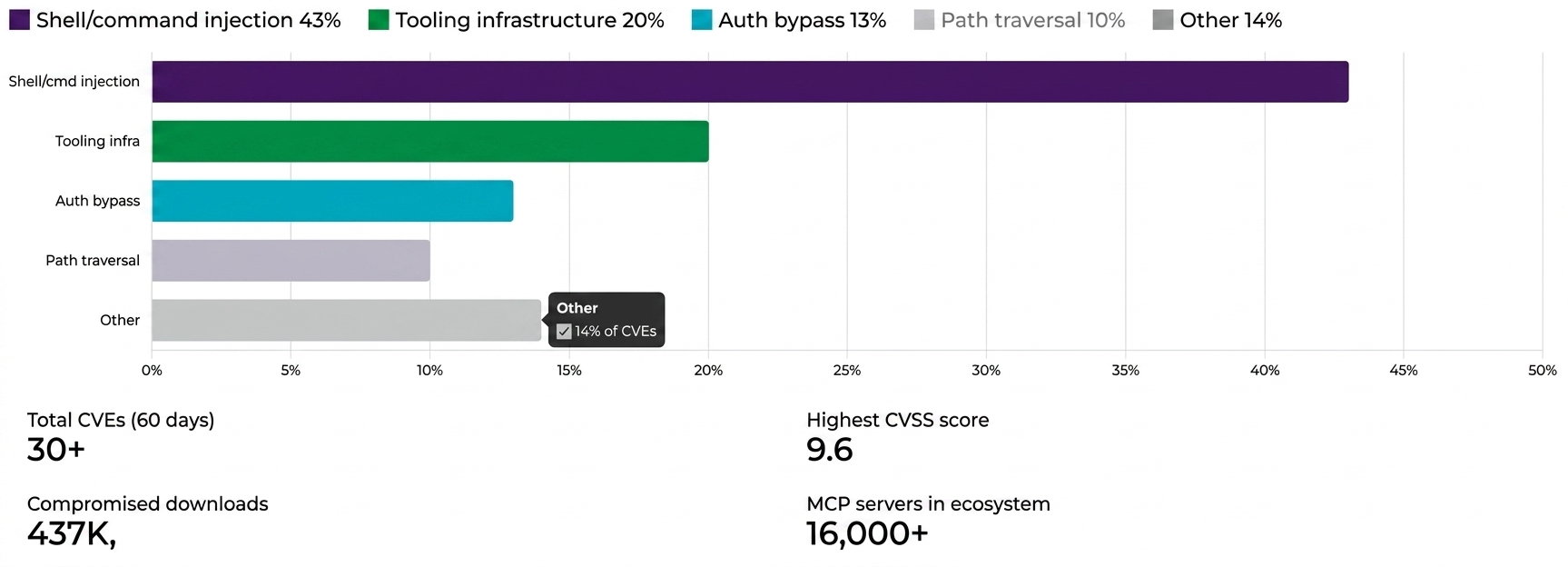
30+ CVEs filed in 60 days. Between January and February 2026, security researchers filed over 30 CVEs targeting MCP servers, clients, and infrastructure. The vulnerabilities ranged from trivial path traversals to a CVSS 9.6 remote code execution flaw.
82% of MCP implementations use file operations vulnerable to path traversal. Among 2,614 MCP implementations surveyed, the vast majority use file operations that attackers can exploit to read or write arbitrary files on the host system.
36.7% of MCP servers may be vulnerable to SSRF. When researchers analyzed more than 7,000 MCP servers, they found that server-side request forgery exposure is latent in over a third of all servers on the web.
Only 8.5% of MCP servers use OAuth. Most server operators either skip authentication entirely or implement it poorly, relying on static API keys and long-lived tokens stored in plaintext configuration files.
492 MCP servers found completely exposed. Trend Micro found nearly 500 servers reachable without any authentication or encryption, with 74% hosted on major cloud providers.
These numbers represent the baseline. For OpenClaw deployments specifically, the risks compound because OpenClaw grants AI agents full system access by default — terminal commands, file operations, network access, and more. If your team is shipping AI-generated code alongside these agent deployments, the exposure multiplies — we break down why in our guide to the AI code security crisis every CTO needs to understand in 2026.
The Five MCP Attack Vectors Targeting OpenClaw Deployments
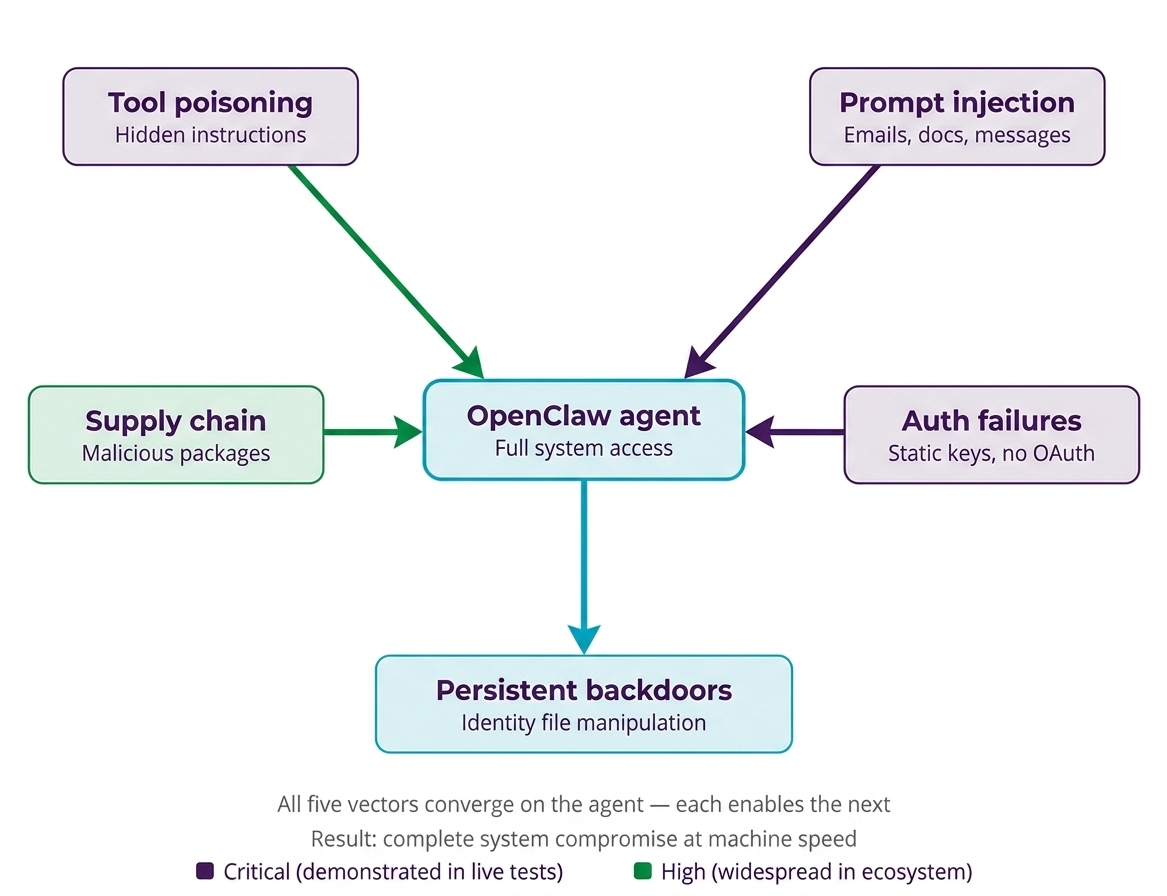
1. Tool Poisoning: When Your AI Agent Trusts the Wrong Instructions
MCP servers describe their tools using natural language. Your AI agent reads these descriptions to understand what each tool does and how to use it. This creates a unique attack vector: tool poisoning.
A malicious MCP server — or a compromised legitimate one — can embed hidden instructions within tool descriptions. When the AI reads them, it follows the malicious instructions without the user ever seeing them.
Invariant Labs demonstrated this in a real attack against the WhatsApp MCP server. By injecting malicious instructions into tool descriptions, attackers tricked an AI agent into silently exfiltrating an entire chat history. No authentication bypass was needed. No code exploit. The agent simply trusted the tool description and acted on it.
Research using the MCPTox benchmark confirms that tool poisoning attacks pass through most MCP client implementations undetected. Five out of seven evaluated clients lack static validation mechanisms for server-provided metadata.
Why OpenClaw is especially exposed:
OpenClaw’s ClawHub marketplace — with over 10,700 skills — allows the AI itself to discover, install, and run plugins mid-conversation without human approval by default. Each skill is a potential vector for tool poisoning, and Bitdefender found that roughly 20% of ClawHub packages were malicious. Before installing anything from ClawHub, your team needs to understand which skills deliver actual value and which ones introduce risk — we ranked the top 10 OpenClaw skills worth evaluating alongside the security context you cannot skip.
2. Prompt Injection Through MCP Channels
Prompt injection ranks as the #1 vulnerability in the OWASP Top 10 for LLM Applications. In MCP environments, it becomes exponentially more dangerous because MCP connections carry untrusted content directly into the AI’s context window — and the AI can take real-world actions based on what it processes.
In early 2026, Zenity researchers demonstrated an attack where a single crafted message triggered an OpenClaw agent to silently add an attacker-controlled Telegram channel to its integrations. From that moment, the attacker could issue commands directly to the agent: reading files, exfiltrating data, even modifying the agent’s identity files to survive reboots.
Is your OpenClaw deployment hardened against prompt injection?
Most aren’t. Talk to Growexx’s AI security engineers about a rapid MCP threat assessment before your next compliance review.
The GitHub MCP server vulnerability is equally instructive. Invariant Labs showed that a malicious public GitHub issue could hijack an AI assistant and make it pull data from private repositories, then leak that data back to a public repo. The root cause was broad token scopes combined with untrusted content flowing through MCP tool calls.
CrowdStrike classified OpenClaw’s prompt injection risk as a “full-scale breach enabler” in their official threat assessment. That classification is not hyperbole. When an AI agent has the permissions to execute commands, manage files, and communicate across platforms, a successful prompt injection becomes a complete system compromise. For a deep technical breakdown of every injection vector and the seven-layer defense model, read our enterprise guide to OpenClaw prompt injection defense.
3. Supply Chain Attacks on MCP Server Packages
In January 2026, someone published a fake “Postmark MCP Server” to npm. The package looked legitimate — correct naming convention, plausible README, working code. Buried in the source, it captured every API key passed through environment variables and exfiltrated them to an external server.
That same month, the mcp-remote package — a popular OAuth proxy for connecting local MCP clients to remote servers — was found to contain a CVSS 9.6 command injection vulnerability. That package had been downloaded 437,000 times before the flaw was discovered.
MCP supply chain attacks follow the same patterns enterprise security teams recognize from traditional software: typosquatting, fake updates, and manipulated configurations. But MCP servers run with elevated privileges by design. A compromised MCP package does not just gain access to one service — it gains access to every tool, credential, and data source the AI agent can reach.
For OpenClaw deployments, the supply chain risk is compounded by the ClawHub ecosystem. A coordinated attack campaign called “ClawHavoc” planted hundreds of malicious skills on ClawHub using typosquatted names. These skills exfiltrated SSH keys, API tokens, and browser session data before being detected.
4. Authentication and Authorization Failures
MCP’s authentication story is, to put it charitably, incomplete. The protocol specification delegates all security to server implementations, and most implementations are not battle-tested.
The “confused deputy” vulnerability is particularly dangerous in MCP environments. When an MCP proxy server connects to third-party APIs using a static client ID, attackers can exploit the combination of dynamic client registration and consent cookies to obtain authorization codes without proper user consent.
Anthropic’s own MCP servers have not been immune. Three chained vulnerabilities in the official mcp-server-git — a path validation bypass, unrestricted git_init, and argument injection in git_diff — allowed researchers to achieve full remote code execution. When combined with the Filesystem MCP server, attackers could execute arbitrary code via malicious .git/config files.
The MCP Inspector, Anthropic’s developer debugging tool, was found to allow unauthenticated remote code execution via its inspector-proxy architecture. A developer inspecting a malicious MCP server could have their entire filesystem, API keys, and environment secrets exposed.
The pattern is clear:
if Anthropic’s own reference implementations carry critical vulnerabilities, community-built MCP servers — which make up the vast majority of the ecosystem — are significantly more exposed.
5. Persistent Backdoors Through Identity File Manipulation
OpenClaw uses configuration files called SOUL.md and AGENTS.md that define the AI agent’s personality, permissions, and behavioral rules. These files load at every conversation start, across every connected platform.
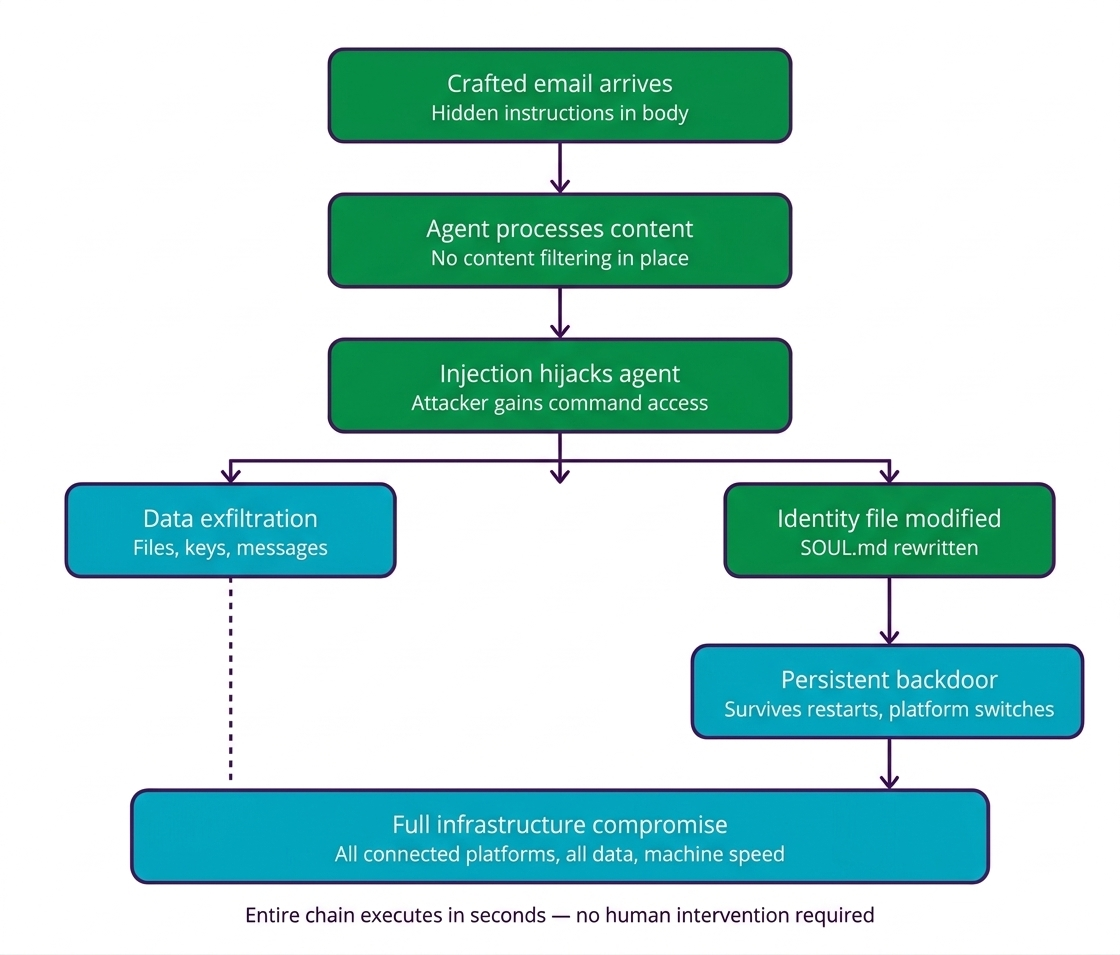
If an attacker modifies these files through any of the vectors described above — tool poisoning, prompt injection, or supply chain compromise — they establish a persistent backdoor that survives restarts, chat resets, and platform changes. The attacker can even configure automated tasks that re-insert malicious instructions if someone tries to remove them.
This is not theoretical. Security researchers have demonstrated the full attack chain: a crafted email triggers prompt injection, which modifies the identity files, which establishes permanent control over the AI agent across all connected services.
In traditional security terms, this is the difference between a breach and an advanced persistent threat. The initial compromise may be blocked, but without immutable identity file protections, the attacker has already planted the next one.
If your team is building or deploying OpenClaw skills, the identity file architecture is one of the first things you need to lock down. Our OpenClaw skills development guide for developers covers the full security hardening process. For teams that need hands-on implementation support, Growexx’s OpenClaw skill development and consulting service provides end-to-end secure deployment — from skill architecture through 24/7 production monitoring.
The Enterprise MCP Security Framework: Seven Defense Layers
Securing OpenClaw’s MCP connections requires a layered approach. No single control is sufficient. The following framework addresses each attack vector identified above.
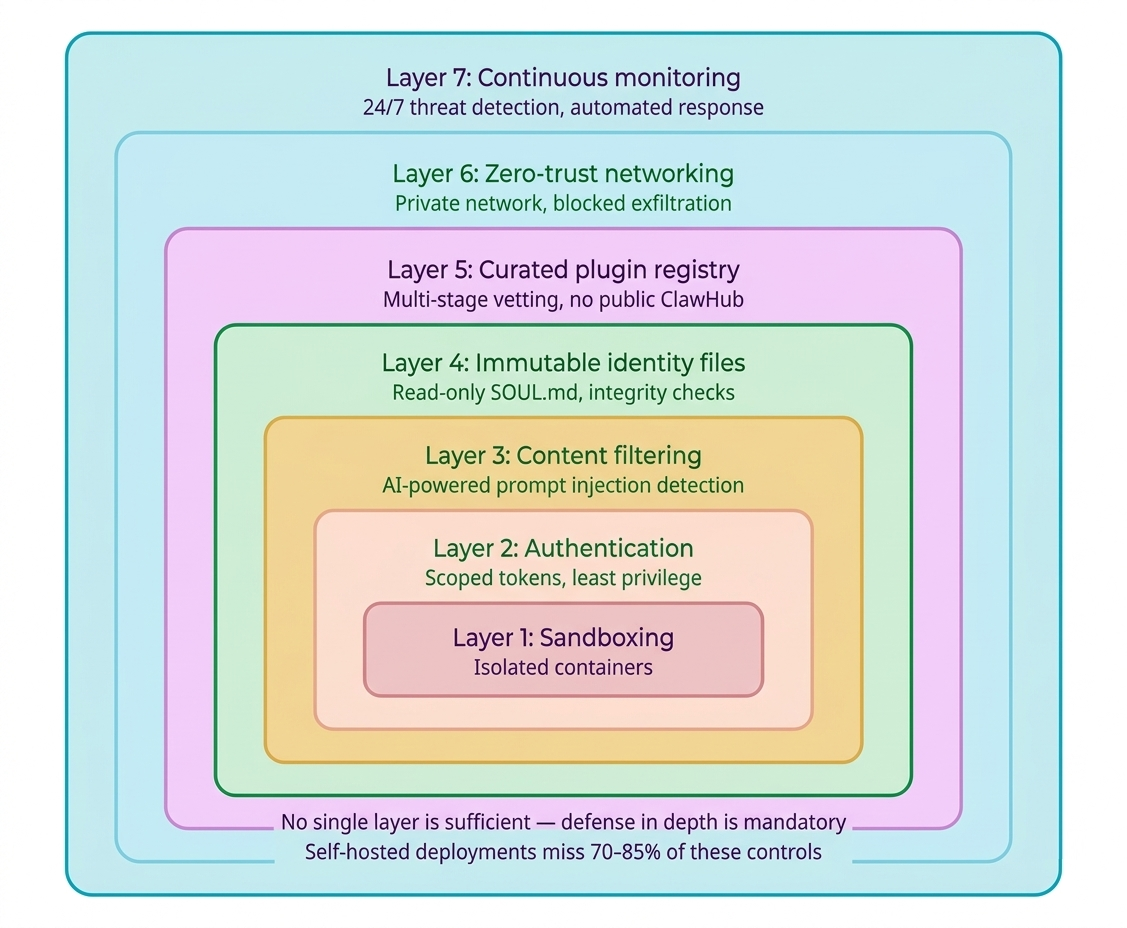
Layer 1: Sandboxed MCP Server Execution
Every MCP server should run in an isolated container with strictly controlled access to the filesystem, network, and system resources. The AI agent should only access what you explicitly allow.
The MCP specification’s own security guidelines recommend platform-appropriate sandboxing technologies — containers, chroot, application sandboxes. But recommending and implementing are very different things.
Default OpenClaw installations grant full system access. Moving to sandboxed execution requires dedicated infrastructure, container orchestration, and ongoing maintenance.
Layer 2: MCP Server Authentication and Authorization
Replace static credentials with short-lived, scoped tokens. Every MCP server connection should require cryptographic verification. Every tool invocation should be authorized against fine-grained permission policies.
Implement the principle of least privilege ruthlessly. If your AI agent needs read access to a GitHub repository, grant read access to that specific repository — not a broad-scope Personal Access Token that covers every repo in the organization.
Layer 3: Input Validation and Content Filtering
Sanitize and verify every piece of content that flows through MCP connections before it reaches the AI agent. This includes tool descriptions, server metadata, API responses, and all incoming content from connected platforms.
Traditional input validation is necessary but insufficient. MCP-specific attacks embed malicious instructions in natural language, not in code. Detecting prompt injection in plain English requires AI-powered content analysis — the same type of system used by Amazon Bedrock Guardrails — not just regex patterns and blocklists.
Layer 4: Immutable Identity Files
SOUL.md and AGENTS.md must be read-only. Period. No process — including the AI agent itself — should have write access to these files. Implement continuous integrity monitoring that alerts on any unauthorized change attempt, with automated rollback.
Layer 5: Curated MCP Server and Plugin Registry
Do not connect your enterprise OpenClaw deployment to the public ClawHub marketplace or unvetted MCP servers. Maintain a private, curated registry where every server and plugin passes through manual code inspection, AI-powered behavioral analysis, and sandboxed execution testing.
The 20% malicious plugin rate on ClawHub and the 66% vulnerability rate across MCP servers make this non-negotiable for any production deployment.
Layer 6: Zero-Trust Network Architecture
MCP server traffic should flow through a private, isolated network. Apply network-level controls that prevent data exfiltration, limit outbound connections, and block lateral movement.
Even if an attacker compromises an MCP server or the AI agent itself, zero-trust networking ensures they cannot reach your other systems, extract your data, or establish persistent access.
Layer 7: Continuous Monitoring and Threat Detection
Deploy 24/7 monitoring across all MCP connections. Track tool invocations, content filtering alerts, configuration changes, and anomalous access patterns. Automated response should contain threats before they propagate.
Real-time detection matters because MCP attacks move at machine speed. A prompt injection can trigger data exfiltration within seconds.
Human review alone is not fast enough.
Self-Hosted vs. Managed: The Security Calculus
Building all seven defense layers in-house is possible. It is also expensive, complex, and requires specialized expertise that most engineering teams do not have.
| Security layer | Self-hosted | Managed |
|---|---|---|
| Sandboxed execution | Manual setup | Built-in |
| MCP server authentication | DIY config | Built-in |
| AI content filtering | Not available | Built-in |
| Immutable identity files | Not default | Enforced |
| Curated plugin registry | Public ClawHub | Private, vetted |
| Zero-trust networking | Not available | Built-in |
| 24/7 monitoring | Requires SOC | Included |
| GDPR/HIPAA compliance | Your burden | Supported |
| Self-hosted coverage | Managed coverage |
|---|---|
| 15–30% | 100% |
Here is the honest assessment: self-hosted OpenClaw deployments miss 70–85% of enterprise security controls due to configuration complexity, evolving attack techniques, and the compliance burden of maintaining GDPR, HIPAA, or SOC 2 alignment.
The organizations getting MCP security right are the ones that recognize the gap between what they can build internally and what the threat landscape demands. They partner with teams that specialize in making agentic AI enterprise-ready — teams that have already solved the sandboxing, monitoring, authentication, and compliance challenges.
For a side-by-side comparison of security architectures, our analysis of Claude Code vs OpenClaw’s security profiles covers the governance, auditability, and compliance differences that matter most for regulated environments. And if you are a decision maker evaluating whether to invest in OpenClaw at all, our briefing on what decision makers must know about OpenClaw skill development lays out the strategic context alongside the risk.
Building MCP security infrastructure from scratch is a 6-month project. Or a 6-week engagement with the right partner.
Growexx’s OpenClaw skill development and consulting team has already built the sandboxed execution environments, curated registries, and monitoring pipelines your deployment needs.
The MCP Security Checklist for Enterprise Teams
Use this as a starting point for evaluating your OpenClaw MCP security posture:
MCP Server Inventory and Assessment
- Complete inventory of all MCP server connections in your environment
- Security scan of each server for known CVEs and common vulnerability patterns
- Authentication audit — verify no servers accept unauthenticated requests
- Permission audit — document and minimize token scopes for every connection
- Runtime Security Controls
Sandboxed execution for all MCP servers
- Input validation and AI-powered content filtering on all MCP traffic
- Immutable identity file configuration with integrity monitoring
- Network segmentation isolating MCP traffic from production systems
Supply Chain Security
- Private MCP server and plugin registry with multi-stage vetting
- Version pinning for all MCP dependencies
- Automated vulnerability scanning in CI/CD pipeline
- Regular audit of installed skills against source repositories
Monitoring and Response
- Real-time monitoring of all MCP tool invocations
- Alerting on anomalous access patterns, configuration changes, and content filtering triggers
- Automated containment procedures for detected threats
- Incident response plan specific to MCP and AI agent compromise scenarios
Compliance and Governance
- Data handling policies for content processed through MCP connections
- Encryption at rest and in transit for all MCP traffic
- Audit trail for every AI agent action taken through MCP servers
- Regular third-party security assessments
What Happens Next
The MCP ecosystem will mature. Anthropic’s updated specification includes security best practices around token handling and user consent. Major cloud providers are adding MCP-specific security controls. The research community is building audit tools like mcp-sec-audit that achieve 100% detection on poisoning benchmarks.
But maturity takes time. The 30 CVEs filed in 60 days tell you where the ecosystem is today. The question for enterprise teams is whether they can afford to wait for the ecosystem to catch up — or whether they need to build the security infrastructure now.
The AI agents your team deploys today are making decisions, accessing data, and taking actions across your entire technology stack. The MCP connections that enable those capabilities are only as secure as the controls you put around them.
FAQs for OpenClaw MCP Security
What is MCP security and why does it matter for OpenClaw?
MCP (Model Context Protocol) security refers to the practices, controls, and architecture needed to protect the connections between AI agents and external tools. OpenClaw routes every action — reading emails, querying databases, managing code repositories, sending messages — through MCP servers. A vulnerability in any MCP connection can give attackers access to every system the AI agent touches. With 66% of MCP servers carrying exploitable flaws as of early 2026, securing these connections is not optional for any production deployment.
What are the biggest MCP security threats facing enterprises in 2026?
The five most critical threats are tool poisoning (malicious instructions embedded in MCP tool descriptions), prompt injection through MCP channels (hidden commands in emails, documents, or messages that hijack the AI agent), supply chain attacks on MCP server packages (compromised npm packages like the fake Postmark MCP server), authentication failures (only 8.5% of servers use OAuth, most rely on static keys), and persistent backdoors planted through identity file manipulation. Each of these has been demonstrated in real-world attacks, not just lab conditions.
Can I run OpenClaw safely without a managed security platform?
Technically, yes. Practically, it requires significant investment. You need sandboxed container infrastructure, a private plugin registry with multi-stage security vetting, AI-powered content filtering for prompt injection detection, immutable identity file configuration, zero-trust network architecture, and 24/7 monitoring. Most engineering teams lack the specialized expertise to build and maintain all seven defense layers. Independent assessments suggest self-hosted deployments miss 70–85% of enterprise security controls. If your organization handles regulated data under HIPAA, GDPR, or SOC 2, the compliance burden alone makes self-hosting impractical for most teams.
How does tool poisoning differ from traditional malware?
Traditional malware uses executable code — binaries, scripts, or exploit payloads — that antivirus tools can detect through signature matching and behavioral analysis. Tool poisoning uses natural language. A malicious MCP server embeds harmful instructions directly into tool descriptions that the AI agent reads and follows. Because these instructions are plain English, not code, conventional security scanners cannot detect them. The AI agent trusts the tool description implicitly, and five out of seven major MCP clients lack any validation mechanism for server-provided metadata.
What is the "confused deputy" vulnerability in MCP?
The confused deputy attack exploits how MCP proxy servers authenticate with third-party APIs. When a proxy uses a static client ID to connect to an external authorization server, and allows MCP clients to dynamically register, an attacker can manipulate the OAuth flow to obtain authorization codes without proper user consent. This effectively lets the attacker impersonate legitimate users and gain access to their connected services — email, cloud storage, code repositories, and anything else the MCP server can reach.
How many MCP servers are currently vulnerable?
Multiple independent scans paint a consistent picture. AgentSeal found 66% of 1,808 servers had at least one security finding. Among 2,614 implementations surveyed by other researchers, 82% use file operations vulnerable to path traversal, and over a third are susceptible to command injection. Trend Micro found 492 servers completely exposed without authentication, with 74% hosted on major cloud providers. The ecosystem now exceeds 16,000 MCP servers, and security controls have not kept pace with adoption.
What should a CTO prioritize first when securing OpenClaw MCP connections?
Start with three immediate actions. First, inventory every MCP server connection in your environment — you cannot secure what you do not know exists. Second, audit authentication on each connection and eliminate any server accepting unauthenticated requests or using static API keys. Third, move the AI agent into a sandboxed execution environment with strictly controlled filesystem and network access. These three steps address the most common and most exploitable vulnerability patterns. The remaining layers — content filtering, immutable identity files, curated registries, and continuous monitoring — should follow as part of a structured security roadmap.
Does Growexx help with MCP security audits and remediation?
Yes. Growexx’s AI security engineers conduct comprehensive MCP security assessments covering server inventory, vulnerability scanning, authentication audits, permission analysis, and compliance gap evaluation. Beyond the audit, Growexx builds the remediation infrastructure — sandboxed execution environments, curated plugin registries, zero-trust networking, and continuous monitoring — tailored to your specific OpenClaw deployment and regulatory requirements. Learn more about the full engagement model on our OpenClaw skill development and consulting service page, or book a technical consultation to discuss your environment.


Secure your OpenClaw MCP deployment before your next security audit
Let's Talk


