


Key Takeaways:
- AI development is not just model integration; it is the process of building production-ready AI systems that improve business workflows.
- The biggest enterprise opportunity is moving from AI pilots to measurable business outcomes.
- Strong AI ROI comes from reducing manual work, improving decision speed, increasing accuracy, lowering risk, and improving customer experience.
- AI agents, automation, custom AI apps, copilots, and RAG systems all solve different business problems.
- Enterprises should start with one high-value workflow, define success metrics, validate data readiness, and scale with governance.
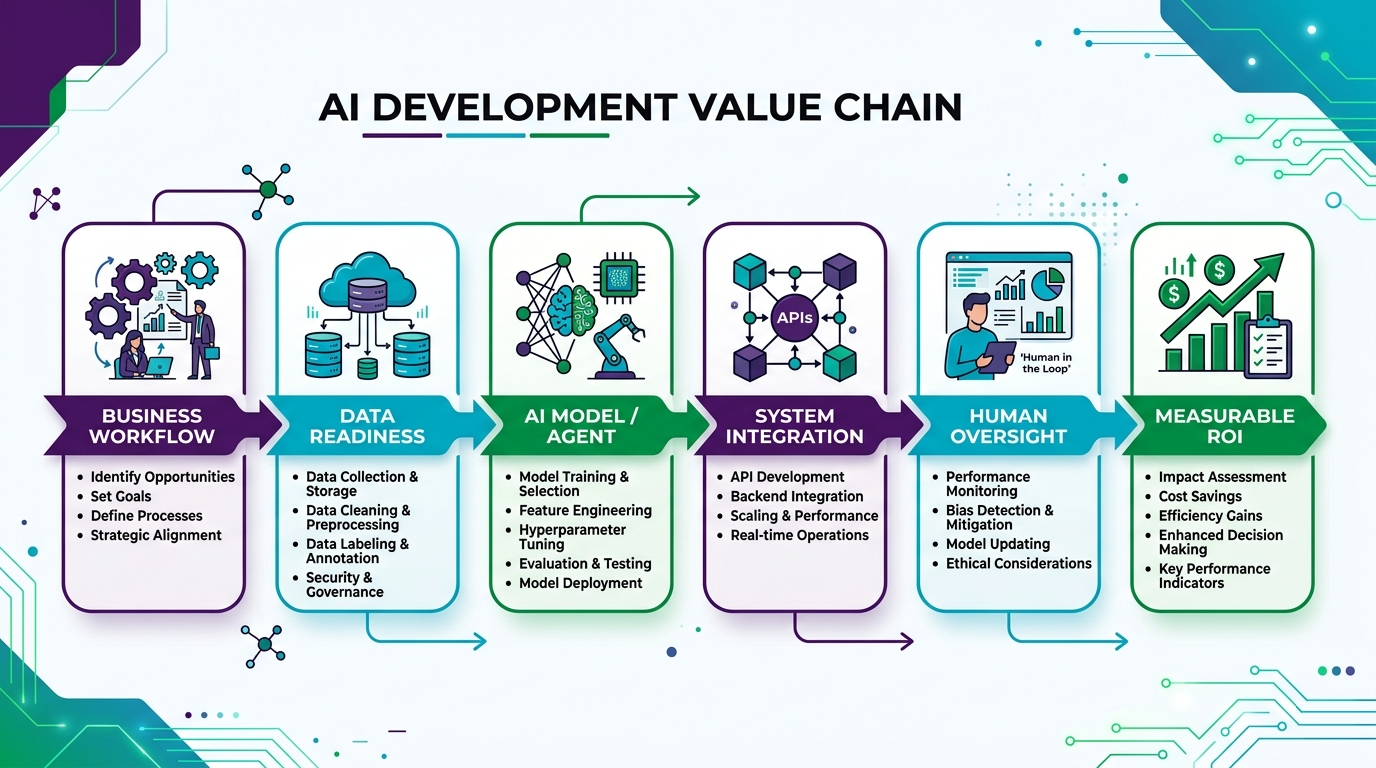
AI development is the process of designing, building, integrating, and scaling artificial intelligence systems that improve how a business operates. For enterprise leaders, the real value is not the model itself. It is what the model changes: faster decisions, lower manual effort, better customer experiences, smarter operations, reduced risk, and measurable return on investment.
This matters because AI has moved beyond experimentation. McKinsey’s 2025 State of AI report found that 88% of organizations use AI regularly in at least one business function, but nearly two-thirds have not scaled AI across the enterprise. That gap is where business value is won or lost.
For GrowExx, AI development means building AI systems that change how enterprises operate. It is not about creating disconnected demos or adding another tool to an already crowded technology stack. It is about embedding intelligence into ERP systems, workflows, products, data systems, and decision processes.
What AI Development Includes
Modern AI development can include several types of solutions:
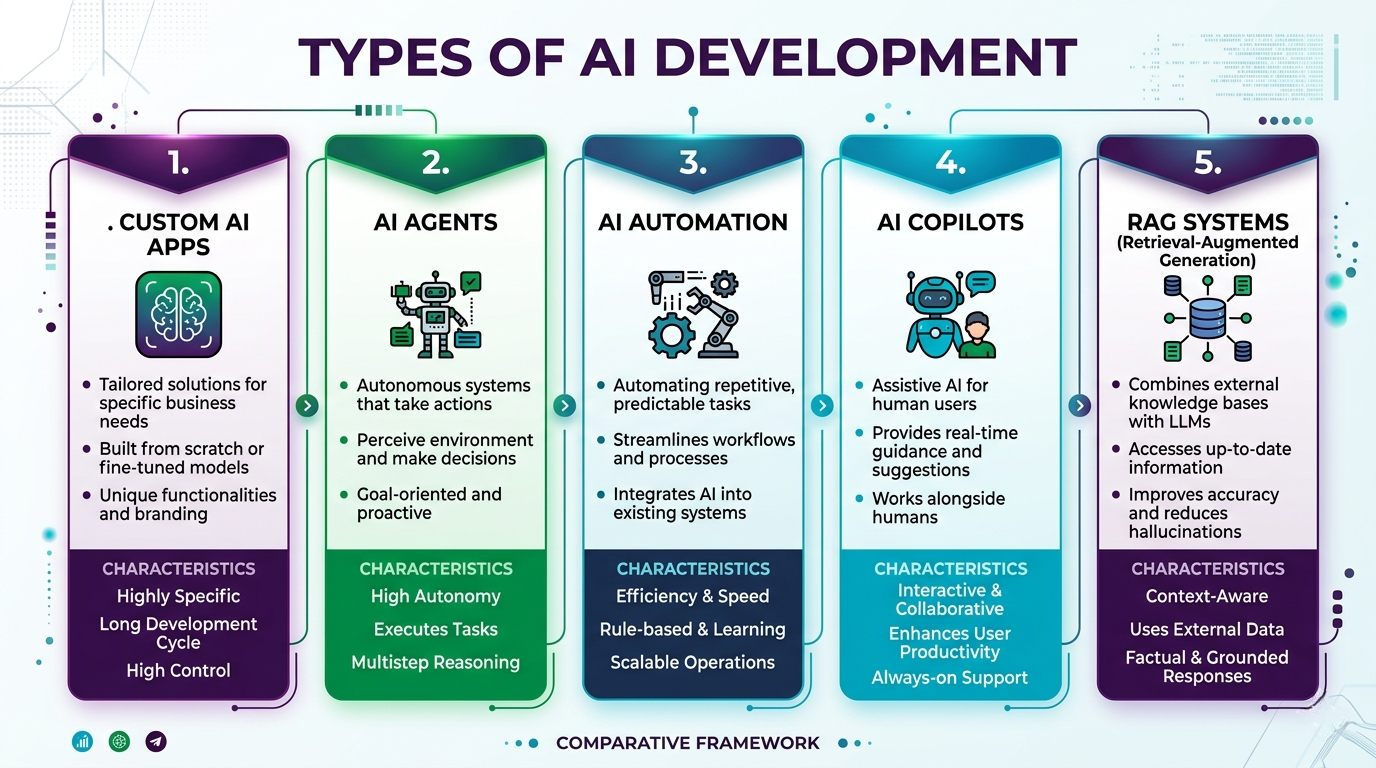
Custom AI applications:
Purpose-built software that uses AI to solve a specific business problem, such as claims processing, demand forecasting, fraud detection, or customer support automation.
AI agents:
Goal-driven systems that can plan steps, gather information, trigger actions, and support multi-step workflows with appropriate governance.
AI automation:
AI-enabled workflows that reduce repetitive manual work across operations, finance, support, logistics, healthcare administration, and retail execution.
LLM and RAG systems:
Applications that connect large language models with enterprise knowledge, documents, policies, tickets, and databases.
AI copilots:
Assistive interfaces that help employees complete tasks faster, such as summarizing records, drafting responses, analyzing trends, or recommending next actions.
AI code audit and validation:
Review of AI-generated or AI-assisted code to make sure it is secure, reliable, maintainable, and production-ready.
Not sure where AI can create the most value in your enterprise?
Why Business Leaders Should Care
The biggest mistake companies make is treating AI development as a technology initiative only. AI creates value when it is connected to business workflows.
For BFSI leaders, that may mean reducing fraud review time, improving document intelligence, or automating compliance-heavy processes.
For healthcare leaders, it may mean reducing administrative workload, improving scheduling, supporting documentation, or streamlining revenue cycle operations.
For logistics leaders, it may mean better exception handling, smarter route planning, improved warehouse visibility, or faster supply chain decisions.
For retail leaders, it may mean better personalization, inventory intelligence, demand forecasting, pricing support, and customer service automation.
In each case, the goal is not “use AI.” The goal is to improve a measurable business outcome.
The ROI Lens
Before starting an AI development project, leaders should define the business case clearly.
Ask:
- Which workflow is slow, expensive, risky, or inconsistent?
- What data is available?
- Which decision or process should improve?
- What metric will prove success?
- Which systems must the AI connect with?
- What governance is required before production?
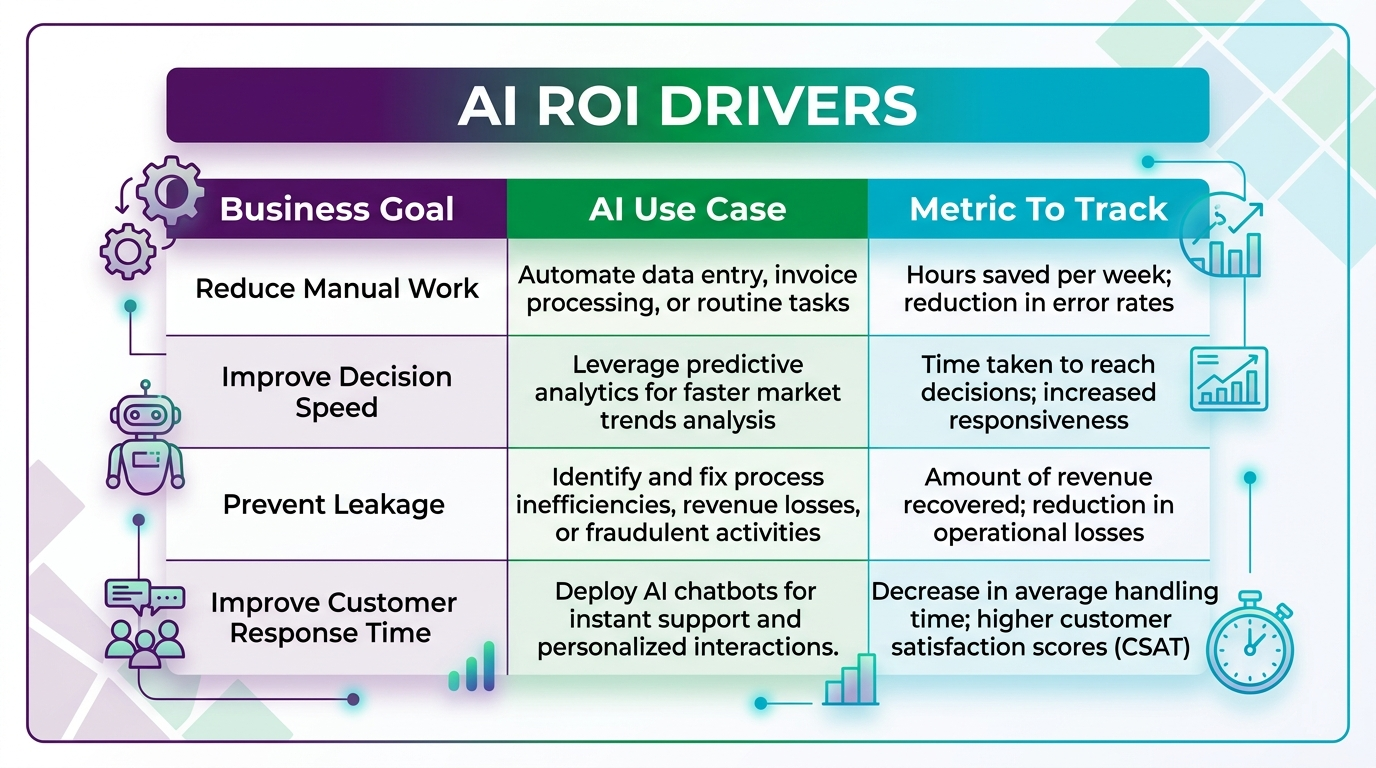
AI ROI usually comes from a mix of productivity gains, cost reduction, revenue lift, faster cycle times, improved accuracy, and reduced operational leakage.
A strong AI project should have a measurable before-and-after view. For example: reduce manual review time by 40%, improve support response time by 30%, reduce inventory stockouts by 15%, or shorten approval cycles from days to hours.
Why Many AI Pilots Fail
Many AI pilots fail because they are built around interesting technology rather than business-critical workflows.
Common failure patterns include:
- No clear owner from the business
- Weak data readiness
- Poor integration with existing systems
- No production governance
- No adoption plan for users
- No ROI model before development starts
This is why GrowExx’s positioning matters: built to run, not to demo. Enterprise AI needs senior engineering, system integration, security, governance, and business alignment from the start.
The GrowExx Approach
GrowExx, a top AI development company, helps enterprises build the intelligence layer their systems are missing.
That means connecting AI development with:
- ERP and Oracle-aware enterprise systems
- AI automation
- Product engineering
- Workflow redesign
- AI agents
- Production validation
- Governance and security
- Business outcome measurement
The strongest AI systems do not sit beside the business. They operate inside the business.
How To Start
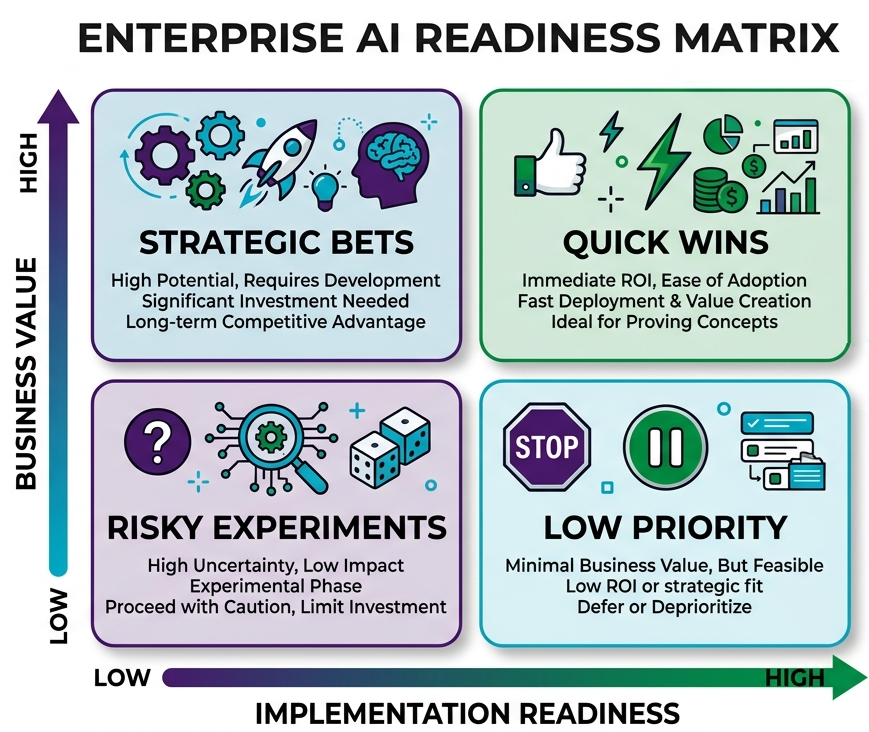
A practical AI development roadmap starts with five steps:
Identify high-value workflows
Look for processes with high volume, repeated decisions, manual effort, or measurable friction.
Validate data readiness
Check whether the data is available, reliable, secure, and usable.
Choose the right AI solution
Not every problem needs an AI agent. Some need automation, some need a custom AI app, and some need better data architecture first.
Build a focused pilot
Start with a narrow use case that can prove value quickly.
Scale with governance
Add monitoring, access controls, human oversight, auditability, and adoption support before expanding.
Move from AI ideas to a production-ready execution plan.
Conclusion
AI development is not just about building AI features. It is about creating production-ready systems that improve how the enterprise operates.
For business leaders, the right question is not “Can we use AI?” The better question is: “Which business workflow should become faster, smarter, and more intelligent first?”
GrowExx helps enterprises answer that question and build the AI systems to make it real.
FAQs on AI Development
What is AI development?
AI development is the process of building, integrating, and scaling AI systems that solve business problems or improve workflows.
What does an AI development company do?
An AI development company designs and builds custom AI apps, AI agents, automation workflows, LLM systems, integrations, and production-ready AI solutions.
How does AI development create ROI?
AI creates ROI by reducing manual work, improving decision speed, increasing accuracy, improving customer experience, reducing risk, and unlocking new revenue opportunities.
What is the difference between AI development and AI consulting?
AI consulting focuses on strategy and planning. AI development includes designing, building, integrating, testing, and deploying AI systems.
How should enterprises start with AI development?
Start with a high-value workflow, validate data readiness, define ROI metrics, build a focused pilot, and scale with governance.


Ready to identify your highest-value AI opportunities?
Book a Discovery Call


