Building an Evaluation Harness for AI Agents
An AI agent evaluation harness is the fixed set of real task instances, graders and thresholds you run an agent …


 45% of AI-generated code contains security flaws that reach production undetected Standard code review catches only 30% of AI-specific vulnerabilities without a dedicated checklistA structured AI code audit can reduce critical pre-launch security risk by up to 80%
The full 15-point checklist is available as a free PDF download below. Here are the first five—the most critical checks that GrowExx engineers verify in every audit:
Check 1: Authentication Middleware Is Applied to Every Protected Route
Verify that every route requiring authentication explicitly applies your auth middleware. AI-generated routing code frequently creates endpoints that bypass middleware that was correctly applied elsewhere. Test: make unauthenticated requests to every endpoint and confirm 401 responses where expected.
Check 2: JWT Tokens Are Fully Validated (Not Just Decoded)
Verify that your JWT implementation checks the signature, expiry, issuer, and audience claims. AI coding tools regularly generate JWT decode-only implementations that accept unsigned tokens. Test: send a JWT with an invalid signature and confirm it is rejected.
Check 3: No Credentials Exist in Source Code or Git History
Run GitGuardian or TruffleHog against your full git history, not just the current working tree. AI tools replicate credential patterns from training data. A secret committed 6 months ago and “deleted” is still in your git history. Test: run `git log –all -p | grep -i ‘api_key\|secret\|password\|token’`
Check 4: All Database Queries Use Parameterized Statements
Search your codebase for string concatenation in database queries. AI-generated data access code frequently builds queries dynamically without parameterization. Test: search for patterns like `”SELECT * FROM ” + ` or f-string/template-literal usage in query construction.
Check 5: All AI-Suggested Dependencies Exist in the Official Registry
Cross-check every package in your package.json or requirements.txt against the official npm or PyPI registry. Run Socket.dev against your dependency tree. AI tools reference packages that don’t exist—and attackers register those names. Test: npm ls –depth=0 combined with Socket.dev analysis.
According to industry research, 45% of AI-generated code contains security flaws, 62% has design vulnerabilities, and AI-generated code is now the cause of 1 in 5 breaches. Startup CTOs are no longer asking whether to audit AI-generated code before deployment, but how to do it without slowing their team down.
Learn how engineering teams at seed-to-Series-B startups are eliminating manual security gaps, catching hallucinated dependencies before they ship, and building production confidence into every AI-generated code merge — using a 20-point framework built specifically for the vulnerability classes these tools introduce.
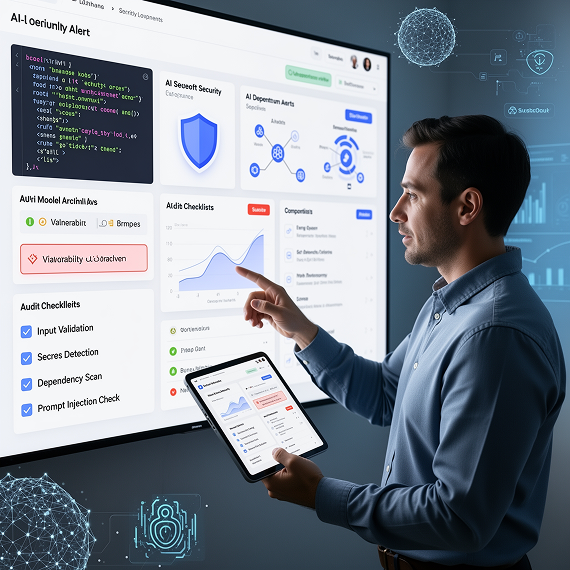

Replace ad-hoc spot checks with a structured 20-point framework built for the vulnerability classes AI coding tools consistently introduce. Every engineer on your team runs the same review every time.

Hallucinated packages, hardcoded secrets, missing resource-level authorization, prompt injection surfaces — this checklist targets the failure patterns unique to AI code generation, not generic security advice repurposed from a different context.

Band your codebase from Ship with Confidence to Halt Deployment. Use the scorecard before investor demos, Series A due diligence, or SOC2 preparation to give stakeholders a clear, documented security position.

No dedicated security engineer or expensive tooling required. A single engineer completes all 20 checks in under 60 minutes using tools your team already has — Snyk, TruffleHog, Semgrep, and standard dependency scanners.

Drop the checklist directly into your pull request template. Every AI-generated code merge follows the same standard automatically — no security expertise required, no additional process overhead.

Growexx’s 200+ engineers have reviewed AI-generated codebases across SaaS, fintech, and healthtech. Every checklist item reflects what we actually find in production — not theoretical textbook vulnerabilities.
Build the security case for pre-deployment AI code review with a documented framework and production readiness scorecard — ready to share with investors, compliance teams, and engineering leadership.
Get the tactical audit process for catching the security gaps AI tools introduce before your first enterprise customer, your Series A, or your SOC2 audit begins.
Understand the complete AI code vulnerability landscape and how a structured review process delivers measurable security coverage without slowing your team’s AI-powered development velocity.
Learn how a structured checklist transforms daily AI code review into a repeatable, low-friction workflow — and creates opportunities for proactive security contribution on every PR.
Startup CTOs reduce critical pre-launch security risk by up to 80% with a structured AI code audit process. Download the free checklist, run it today, and know exactly where your codebase stands before the next release, the next investor call, or the next customer demo.
An AI agent evaluation harness is the fixed set of real task instances, graders and thresholds you run an agent …
Prompt injection in an enterprise AI system is the insertion of instructions into content an agent reads, so the agent …
An approval gate is a control point in an agentic workflow that suspends an agent between deciding to take an …


